
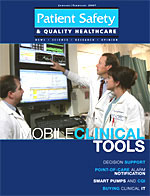
My story on point of care alarm notification was published in Patient Safety & Quality Healthcare magazine this month - my first story with references! Readers of this blog know alarm notification is a pet peeve of mine, and an unmet market requirement that most vendors to date have successfully avoided meeting. I got to interview some really knowledgeable folks for the story who provided great insights. Thanks to Jim Biondi, Charles Fox, William Hyman, and Brian McAlpine for your time and efforts on behalf of improved patient safety.
After describing alarm notification challenges and related patient safety issues at the point of care, the story dives into issues of both alarm delivery and the quality of alarms.
According to healthcare information technology veteran Charles Fox, "Using connectivity between medical devices and clinical information systems, we can be smart enough to let the clinician know what to focus on and what not to focus on; we need to help clinicians focus on the clinically significant data." Alarms must be truly actionable to improve patient safety.
The integration required for this goes beyond a single parameter and its normal values and must evaluate parameters within the context of other parameters derived from other devices and data from information systems. This broader context results in patient-specific normal parameters that change over time. Traditional threshold alarm limits generate many false positive alarms of little clinical value. Adding decision support and specificity is critical to reducing false positive alarms.
Both Emergin's and Cardiopulmonary Corp's Bernoulli Enterprise systems are discussed as examples of how some vendors are pushing the alarm notification envelope. No vendor has a complete solution in this area yet, but these two companies - and a few others - are the pioneers. The big established medical device vendors have created a strategic niche market for vendors like Emergin and Cardiopulmonary by not delivering on alarm improvements. Other factors contributing to the lack of progress in alarms revolve around the structure of the medical device market, and vendor's propensity for proprietary end-to-end solutions.
Most current systems are not real time. They collect data in real time, but don't do anything with it until they're asked for it. In a typical use case, data acquired from medical devices goes to a queue that waits for a clinician to validate the data before it's pushed into the chart. The challenge is to move some part of the system from off-line to real time. This level of interoperable connectivity requires cooperation between vendors. But medical device vendors want to control the mechanisms and alerts associated with their devices to create end-to-end proprietary solutions. And healthcare IT vendors want to extend their products into point-of-care systems currently provided by device vendors. Getting direct competitors or even potential competitors to work together has been difficult. So far, only a few third parties like Cardiopulmonary and Emergin have been able to extract the necessary cooperation to realize truly innovative products.
Without pressure from the market, common business concerns will keep device and healthcare IT vendors from collaborating on solutions that could help solve persistent alarm notification problems.
Providers share at least some of the responsibility for the lack of progress in alarms.
Hyman observes that vendors meet market demands, and that providers must get more demanding with regard to patient and caregiver centric solutions for the point of care. Providers should identify gaps in current alarm notification systems and draft requirements for future purchases. "Unfortunately, not many hospitals have the resources to do this effectively," says Hyman, "and tend to rely too much on rosey vendor characterizations." This process can be done by individual providers, as a collaborative effort among providers, with a consultant, or with vendors.
Jim Biondi summarizes alarm trends with this observation:
"Alarm management is evolving into a clinical management tool," says Biondi. As more patient data becomes available, the management of that data will support earlier clinical interventions, more effective alarms, and better patient outcomes. The real value in the digitalization of the hospital lies in better patient clinical management, safety, and triage.
The potential for change in the medical device industry alluded to the statement above boggles my mind. The traditional functions of bedside medical devices - acquiring physiological patient data, therapy delivery, surveillance and alarm notification - are mature and undifferentiated technologies. The future will be the device as a clinical management tool.
Be sure to read the whole thing. Pictured above is the cover of the current issue of Patient Safety & Quality Healthcare magazine - there's also a pretty cool story in this issue on Global Care Quest and their clinical information system.



Recent Comments