2012 – Year for mHealth?
I received several items in my email regarding different organizations’ proclamations for 2012. Most of them predict that 2012 will be the year for mHealth to ‘break-out.’ Here are 5 examples:
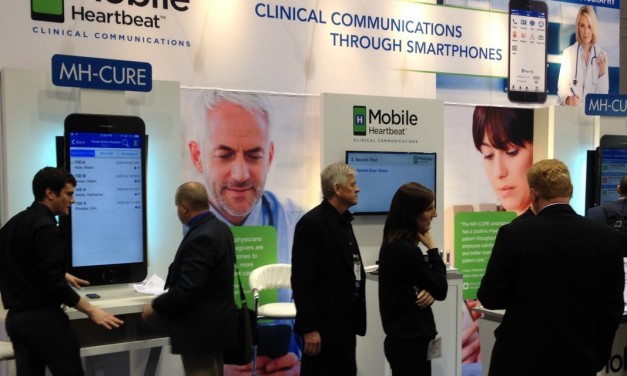
- HIMSS 2012 is focusing on mHealth with several sessions and will have a kiosk on the vendor floor which features speakers on the mobile aspect of healthcare
- AAMI has published in their IT World column a synopsis of mHealth (requires login credentials)
- Here in Europe, the Mobile World Congress, Barcelona Feb 2012, sponsored by the GSM Association, has a track devoted to mHealth (filter for Mobile Health), a day of demonstrations and a specific plan on embedded mobile medical functionality.
- Additionally, the FDA has come out with draft guidance and has promised final guidance regarding mobile medical apps. The European Commission has entered into an MOU with the HHS to work together on the regulatory aspects of healthcare. I wouldn’t be surprised if they come out with similar regulatory guidance regarding mHealth as that promulgated by the FDA.
Market Trends Series #3: Shift from Dept to Enterprise Focus
From what I have observed over many years, Hospitals have historically approached medical device connectivity projects as a tactical issue to be dealt with. Up until relatively recently, technology alone could be used to solve the connectivity issue (i.e. getting data from point A to point B) with little to no negative impact on clinical workflow. Further, the scope of connectivity projects has been mainly departmentally focused and deployments have been relatively basic. By basic, I refer to projects that have focused on connecting one or two bedside medical devices to a single CIS application or EMR.
Evidence of all of this can be found by looking back at the past 10 or more years and examining typical implementations of biomedical device connectivity to information systems.
• Most implementations up to now have been in very specific care areas such as the ICU and OR.
• Most implementations are relatively small in scope, often in the area of about 20 to 50 beds. Incidentally, for most US hospitals this happens to be about the same number of ICU beds per facility.
• In the ICU, the key devices that are interfaced are typically multi-parameter patient monitors and sometimes ventilators – but vents to a much lesser degree than monitors.
• In the OR, the key devices are typically patient monitors and anesthesia/gas machines.
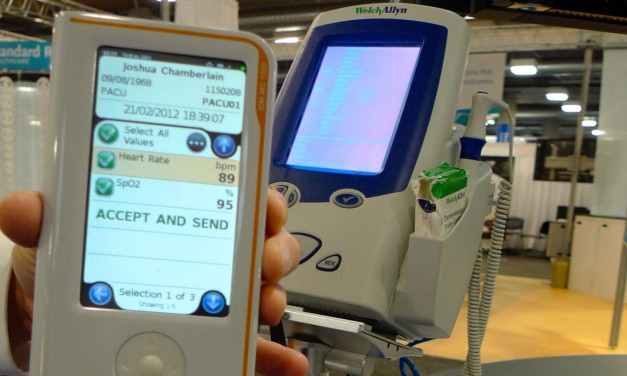
• Outside of high-acuity care areas, in the general ward there are some limited niche interface solutions for mobile vital signs data capture. Many of these are only semi-automated in terms of truly automating both the data capture and the clinical workflow.
• For virtually all of these implementations, the data collected from the devices is identified though a mapping of the medical device’s location – that is a bed or room location identifier is used to associate the data and alarms.
• The device workflow – that is the steps clinicians are required to perform at the bedside to interact with devices to establish connectivity – has been limited. This is because most of the devices are actually fixed to the location – i.e. the monitors in ICU are mounted to the wall and data is interface via a networked gateway with outbound HL7. Therefore few if any steps are required by clinicians because the devices are permanently tethered to a local PC or terminal server that facilitates the data collection.
But as discussed in some of my previous market trends postings – requirements for connectivity have been changing and in some not so subtle ways. Many hospitals are
Read MoreMedical Device Open Source Frameworks
The Big Picture
Medical device interoperability and standardization is a hot topic, and with the efforts surrounding adoption of the 11073 standard, IHE and patient care device frameworks, and the drive towards implementing electronic medical records, the field has become essential to the future of the healthcare industry. Yet, as we look to realign medical devices and their communication mechanisms away from proprietary intercommunication and towards standards-based communication, we should think “outside the box” to other fields, technologies and technical disciplines for inspiration and guidance on best practices. Perhaps an obvious one that comes to mind is the USB 2.0 standard. The simple idea being proffered is the ability to plug a medical device into a computing platform and have it recognized and joined automatically to the operating system. While we are a long way from this vision as a universal standard, there is ample evidence to demonstrate its feasibility in the existing Windows and MAC OS architectures today.
Driver Bundling
Key to the seamless and universal use and acceptance of USB devices is the bundling of device drivers delivered as part of base operating systems. When a new device is developed, it could be adopted for incorporation within the base Windows and Mac operating system environments. However, even before that adoption, manufacturers of these drivers could consider bundling them as part of hardware delivery. The drivers could be installed at run time or prior to usage and, from there, no other special attention would be required: attaching a medical device to an accompanying computing platform would automatically result in that device “joining” with the base operating system. The challenge, of course, is how best to develop drivers that support consistent and common access to data. While the common Patient Care Device (PCD) framework fosters such an idea, it has yet to be realized as a universal standard.
One theme embodied by the IHE medical device connectivity demonstrations featured at HIMSS 09 (pdf) in Chicago was that of following a patient from admission through a critical care room, in which patient information was gathered at the bedside from and to the various medical devices present there, including infusion, bed, monitor, and mechanical ventilation. The ability to collect and integrate these data into a bedside electronic health record was accomplished in concert among the several medical device manufacturers through access to the communication frameworks peculiar to the many vendors participating in the demonstration. The bundling of device drivers and publishing of a common syntax required to communicate with the various devices could provide a starting point for enabling universal biomedical device communication.
Read MoreFacing FDA Regulations for the First Time
A growing number of organizations — large and small, within health care and outside of it — are facing regulation by the FDA. Those potentially affected fall into 3 camps. All of the examples I’m going to talk about deal with multi vendor systems (or systems using lots of off the shelf components) that become the regulated medical device.
Just what is a medical device? The legal definition of a medical device is,
an instrument, apparatus, implement, machine, contrivance, implant, in vitro reagent, or other similar or related article, including a component part, or accessory which is:
- recognized in the official National Formulary, or the United States Pharmacopoeia, or any supplement to them, [i.e., a drug]
- intended for use in the diagnosis of disease or other conditions, or in the cure, mitigation, treatment, or prevention of disease, in man or other animals, or
- intended to affect the structure or any function of the body of man or other animals, and which does not achieve any of it’s primary intended purposes through chemical action within or on the body of man or other animals and which is not dependent upon being metabolized for the achievement of any of its primary intended purposes.
According to the New Oxford American Dictionary, a contrivance is “a thing that is created skillfully and inventively to serve a particular purpose.” So a medical device can be made out of anything, as long as it falls under at least one of the three bullets above.
Who Is Impacted?
Read MoreRequirements, Trade-offs and Sales Objections
This is another installment of a series on selling connectivity. You can read the first installment, with links to subsequent posts, here.
There is no one product that best fits every customer’s requirements, yet the goal of product management is to develop product requirements that addresses the greatest portion of the market possible. Of course, it is neigh impossible to create a solution that is optimal for every customer. This raises a couple interesting questions. For any given project, how much of the addressable market’s requirements can be met? How are such trade-offs made, and what is the role of sales in all this?
Security As a Requirements Trade-off Example
A good frame of reference for requirements trade-offs is wireless security for medical devices. There is a plethora of security standards, and the target is always moving; new standards are implemented, some of which have varying degrees of reverse compatibility with previous generations of hardware, and some require upgrades or replacements to work. Likewise, different markets have different requirements. For example health care has HIPAA, the credit card industry has the PCI data security standard, and other industries have their own requirements. Next, individual customers make security choices based on the infrastructure installed, how current their infrastructure is (is it currently sold by the vendor, is no longer sold but still supported, or is it discontinued), and what security standards they chose to adopt and enforce (sometimes chosen capriciously, often enforced vociferously) in their enterprise.
Like the workflow automation that wireless connectivity enables and the necessary security required to support it, there is a finite degree of requirements variability that can be practically implemented — systems can’t be everything to everyone. Creating a product that address 100 percent of the target market is virtually impossible. Trade-offs must be made so that a product can also reach cost of goods, design budget and time to market objectives.
Read MoreInteroperability – Barriers to Adoption
There’s been some great comments on the recent post about the announcement of MD FIRE. That plus some other activities I’ve been involved in have inspired some thoughts on barriers to adoption for medical device interoperability.
For this discussion, interoperability refers to the ability of a medical device to be controlled by another medical device or third party information system. Medical device systems from a single vendor frequently include interoperability between the medical devices and applications running on general purpose computers, but since all the components are from the same vendor I’m excluding them from this discussion.
Like everything else, medical device interoperability will walk before it runs. In a recent comment, JimW suggests that MD FIRE’s focus is on driving the adoption of, “tightly coupled, low latency, deterministic connection[s].” I beg to differ; I found the MD FIRE text to be very general and that it avoided any kind of design solution whatsoever. Further, it is interesting that what little multi vendor interoperability that is actually on the market, is based on “tightly coupled, low latency, deterministic connection[s].” The example that comes to mind (actually the only one I can think of right now) is the use of CANopen to integrate radiographic equipment with contrast injectors in diagnostic imaging. Perhaps someone can provide additional examples.
Jim is right that such interoperability presents considerable product design and verification challenges, which is why I think that a different kind of interoperability will broad gain market traction before designs with tightly coupled deterministic connections. If you’ve heard Julian Goldman speak on this topic, he provides numerous examples of interoperability that revolve around simple safety interlocks like:
- Using a patient monitor to cease therapy delivery (and sound an alarm, of course) on a PCA pump when respiratory arrest is detected,
- Linking a heart lung machine and ventilator in surgery to ensure that one is turned on when the other is turned off, and
- Linking diagnostic imaging with a ventilator to ensure ventlation is restarted after it is stopped to reduce motion artifact during imaging.
A portion of the 500 patients who die unnecessary deaths every day in U.S. hospitals are killed because simple safety interlocks like these don’t exist. Why? Clearly such interoperability is not rocket science.
Read More