mHealth update – Sept 2012
Since my last blog post here at Medical Connectivity there have been some mHealth updates that may be of interest to the blog readers.
USA and FCC
Just this week the FCC released its task force findings on mHealth. The overarching goal given to the task force was: “By 2017 mHealth, wireless health and e-Care solutions will be routinely available as part of best practices for medical care.” They were to produce actionable recommendations that could be taken by the FCC, other regulatory agencies and industry to reach this goal. The FCC committed to implementing five specific actions in the list produced by the task force:
Read Morea) Immediately recruit for an FCC Medical Director position
b) Develop and execute a health care stakeholder outreach plan to promote greater collaboration between the FCC and the health care sector on policies at the intersection of communications and health.
c) Direct the International Bureau to work with FCC counterparts in other countries to encourage them to make spectrum available for MBANs and to discuss possible spectrum harmonization to allow for medically safe cross-border patient travel and better economies of scale for device makers.
d) Consider an Order by the end of this year to comprehensively reform and modernize the Rural Health Care Program, and
e) Consider an Order by the end of this year to streamline our experimental licensing rules to promote and encourage the creation of wireless health “test beds” to permit easier testing of mHealth devices.
2012 – Year for mHealth?
I received several items in my email regarding different organizations’ proclamations for 2012. Most of them predict that 2012 will be the year for mHealth to ‘break-out.’ Here are 5 examples:
- HIMSS 2012 is focusing on mHealth with several sessions and will have a kiosk on the vendor floor which features speakers on the mobile aspect of healthcare
- AAMI has published in their IT World column a synopsis of mHealth (requires login credentials)
- Here in Europe, the Mobile World Congress, Barcelona Feb 2012, sponsored by the GSM Association, has a track devoted to mHealth (filter for Mobile Health), a day of demonstrations and a specific plan on embedded mobile medical functionality.
- Additionally, the FDA has come out with draft guidance and has promised final guidance regarding mobile medical apps. The European Commission has entered into an MOU with the HHS to work together on the regulatory aspects of healthcare. I wouldn’t be surprised if they come out with similar regulatory guidance regarding mHealth as that promulgated by the FDA.
Convergence Summit – Day One
I’m at the Wireless-Life Sciences Alliance conference, called the Convergence Summit, May 13 and 14. Held at the Estancia La Jolla hotel, today was a full house — standing room only. A few of us are also Twittering the event; you can search for #wlsa to pull up everyone’s posts. You can also see the Summit agenda and prestentors here.
During breakfast, I chatted with Michael Kurgan, CEO of start-up Service Wing Healthcare. They’re targeting the wireless gateway market to support body area networks. I mentioned a company I heard about yesterday, GainSpan and Michael had some great perspective on the challenges picking tech winners in immature markets. GainSpan has an ultra low power wireless SOC (system-on-chip) that includes an 802.11b radio and two ARM processors, one for the radio and one to drive whatever device the chip is enabling. In an immature market, just because a component comes from a big company does not mean that their component will have long term success. A much smaller competitor with a better solution may win, or the big company may acquire a better solution in order to be a big player in that market segment.
Rob McCray, chair of the Wireless-Life Sciences Alliance, kicked things off. Camille Sobrian was up next, touting San Diego as the biggest wireless hot spot in the world (perhaps for cellular wireless). She also mentioned the West Wireless Health Institute, and the upcoming TEDMED event. Dr. Paul Jacobs, CEO and chair of Qualcomm passed on introductory remarks and jumped right into things wireless.
Paul noted that what’s going on right now is convergence, and it’s those who understand both industries that can lead that convergence. He described the new mobile internet experience: networks, devices and applications in the cloud. Multiple air interfaces are a key enabling component. The newest radios are only a few percent more efficient, but they tend to support broader bandwidth to improve network performance. He mentioned a mobile WAN, and various wireless LANs and BANs. A future trend is where applications control the radio to optimize performance for that application.
In Europe, mobile broadband radio dongles for connecting laptops outsell all the 3G phones sold there. Paul defined convergence as the overlapping of computing devices, consumer electronics and wireless tech. Paul alluded to the Amazon Kindle, as a prototypical device for the future, where an embedded system includes a cell phone built in for connectivity. He also highlighted Snapdragon as a platform for mobile data processing, multimedia performance, 3G wireless connectivity and the low power consumption.
Read MoreHealthcare Unbound 2008
This week was the Healthcare Unbound conference. Between the considerable innovation in this market, and the openness with which presenters and attendees share information and ideas, this is always a terrific conference.
The following are some notes from some of the more interesting presentations – be sure to keep scrolling, this is a long post! I’ll follow this up with a post on my presentation at this year’s conference, “How the Network Effect Impacts Adoption of Healthcare Unbound Technologies,” and a wrap-up post.
At 8 am Monday morning, Teri Louden kicked things off. She started her career at Baxter Travenol in the 1970s. Referring to The Graduate, Baxter’s innovative technology of the day was plastic IV bags. Today, things have come a long way from plastics to Healthcare Unbound.
There have been few breakthrough industry segments over time – disease management, home infusion therapy, outpatient surgery – and Healthcare Unbound (HU) is an important pioneering new industry segment.
Teri prognosticated that many of the really breakthrough solutions in health care will come from companies outside of health care – mentioning Intel, Qualcomm, and other electronics and communications companies.
Using CardioNet as an example, Teri described how a new type of solution presents substantive challenges for adoption and effective use. The CardioNet value proposition was unique and required new ways of selling, patient use, and reimbursement.
She introduced Vince Kuraitis and David Kibble, and their topic: The Personal Health Information Network (PHIN): Opportunities and Implications for Healthcare Unbound
The Personal Health Information Network (PHIN): Opportunities and Implications for Healthcare Unbound
Vince introduced the topic with a classic example of the network effect, phones. He asked, what is the value of a single phone? The health care industry is currently the equivalent of two phones representing one to one solutions. The real value comes to the fore when many phones are interconnected, allowing users to contact many other users whenever they want.
Read MoreAAMI 2007 – Day Three, Afternoon
The crew from Lehigh Valley presented their experience creating a telemedicine system called aICU (advanced ICU). John Sokalsky lead off, describing how their aICU concept leverages intensivists and critical care nurses in a remote location to serve more ICU patients. The system improves outcomes and reduces costs – always good things. This system integrated their CPOE, meds administration, real-time documentation charting and medical device data via a critical care information system, and finally a camera/digital video system. The strategic initiative was to create and implement an off-site “tele-intensivist” program. This program provides round-the-clock intensivist coverage of critical care units throughout their health care system. Results showed improved patient outcomes and reduced overall costs by managing changes in patient conditions quickly and effectively.
The project was lead by Stephen Matchett, MD, Chair, and Project Sponsor, and included the following team members:
- I/S Applications and Administration
- Clinical Services Administration and leadership
- Respiratory Therapy
- Administrative Planning
- Pharmacy
- Clinical Engineering
- Others invited on as needed basis
The Lehigh Valley system is based on an application from iMDsoft. Device drivers for legacy devices (or devices that do not include connectivity) use serial device drivers written by iMDsoft. Patient context for devices with serial interfaces was done by bed location. [This works fine for an ICU implementation where patients rarely move - connectivity on devices connected to lower acuity patients should establish patient context in the device.] Data was received from devices with built in connectivity (via integrated network support) via HL7 from the device vendor’s HL7 server.
They use HP OpenView to monitor device connectivity as far as the Lantronix terminal server for serial-based devices. Devices with network connections can be monitored by OpenView up to the medical device vendor’s server. The links between the device and the next step (term server or device vendor’s server) is not visible to IT for monitoring. They usually get warning from biomedical engineering when new devices or firm ware upgrades, and test in advance of deployment.
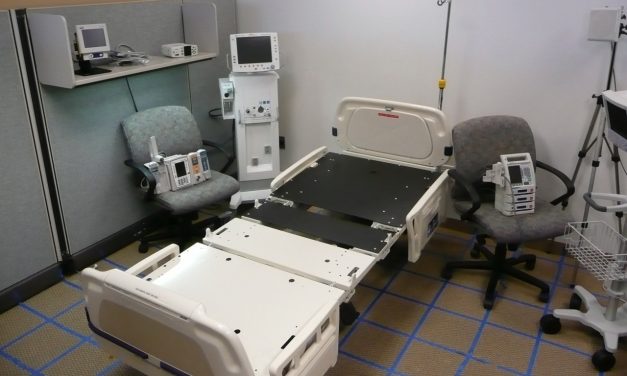
An interesting part of their description of the project includes a test environment. During deployment, this environment was a “simulated ICU” that includes back to back TNICU/MICU beds in test, and four additional beds at remote ends of the ICU. Beds were added until the first twenty eight ICU beds were online. This required continuous coordination with Facilities and Bed Management. As the first 28 bed unit prepared to go live, additional units were subsequently wired & placed in test. This approach offered the following advantages: facilitation of training by department prior to “go live,” and identification and correction of system, device and workflow issues. Once fully deployed, they use spare devices (they’re usually available) to create a test environment as needed.
Surprisingly, they’ve had problems with some vendors getting the data required to develop a serial port device driver.
Christina Roberts, on the IT side, talked about the nursing and clinical engineering relationship. At Lehigh Valley, the IT department facilitates the coordination between nursing and biomedical engineering. The IT department takes calls 24×7 and provides tier 1 support for the aICU (and other clinical information systems). Depending on the problem, they will call biomedical engineering.
Read MoreCongress Contemplates Reporting of ED Boarding Statistics

According to this story in the New York Times, “More than half the doctors from New York State, New Jersey and
Connecticut who responded to a survey conducted in April by the
American College of Emergency Physicians said that boarding had
increased significantly in recent years.” Boarding is the practice of treating patients in hallways of busy Emergency Departments, frequently while waiting for an in-patient bed to become available.
The consequences of overcrowding can be fatal, doctors said. A total
of 150 emergency department doctors in New York, Connecticut and New
Jersey said that patients in their hospitals had died as a result of
boarding, according to the survey by the American College of Emergency
Physicians, a 25,000-member group that is pushing legislation in
Congress to fight hospital overcrowding. The survey specified no time
frame.
The group sent a 10-question survey about boarding to its
2,821 members in New York State, New Jersey and Connecticut. In New
York, 28.2 percent of those responding said they “personally had
experience of a patient dying as a result of boarding.”
In
Connecticut, 16.2 percent of the doctors responding said they had had a
patient die as a result of boarding, and in New Jersey 11.9 percent of
the doctors said they had.
The doctors requested anonymity and
were reluctant to provide details about cases because of possible
lawsuits and other repercussions.
You can chalk up this survey as another example of the increase in reporting of patient safety and outcomes:
Ms. [Julie] Lloyd [a spokeswoman for the American College of Emergency Physicians] said the survey was the first by her group, or any other she
knew of, to try to assess the number of deaths resulting from boarding.
She said in an e-mail message that a key point in legislation before
Congress “is to collect boarding statistics, which heretofore have
remained the province of the hospitals.”
Public reporting of boarding seems to be in our future, nation wide.
A spokeswoman for the New Jersey Hospital Association, Kerry McKean
Kelly, said she had “not heard of any deaths” resulting from boarding
in New Jersey, but “we don’t think there’s any disagreement” that
boarding and overcrowding are serious problems, and “everyone shares
responsibility on this issue.”
Don't kid yourself, boarded patients have died, in New Jersey and beyond. There are no statistics on this because hospitals don't code the cause of death to reflect the preventable adverse event that killed them like, “death from inattention due to boarding.” Harsh? Perhaps, but this is a long standing problem in which most hospitals still wring their hands and ask, “what can we do?” Here's what they did at Stony Brook hospital:
Dr. [Peter] Viccellio [vice chairman of emergency medicine] said 3,000 boarders had gone through the Stony Brook
hospital under his revised system and estimated that hundreds of
hospitals nationwide had begun using it.
The premise of his
regulations: When an emergency department is seriously overcrowded and
patients are boarded in the hallways, their care and that of any new
patient can be jeopardized. So emergency department boarders are moved
to the hallways of inpatient units — 10 at Stony Brook — where they can
be treated in a unit designed for their condition until a room becomes
available. Those units are also less crowded.
Dr. Viccellio
described his plan as a “decompression valve” that relieves the
pressure on emergency departments and results in “better care for all
patients, more timely treatment and fewer errors.”
He created
the system after years of frustration with boarding problems at Stony
Brook — a frustration felt throughout the country, said other doctors
who were interviewed.
Dr. Viccellio’s department often boarded up
to 15 to 20 patients before his protocol. Now, he said, when boarding
occurs it usually involves seven or eight patients. The most common
complaint for boarded patients is chest pains, he said.
Only two
patients can be assigned to another unit, he said, “so you might have a
situation where five nurses are treating 32 patients instead of 30” in
a given inpatient unit. That is far preferable, he said, to the
emergency department bearing the burden of overcrowding by itself.
Some
hospitals have expressed concern about the impact of Dr. Viccellio’s
system on nursing staffs, but spokeswomen for the New York State Nurses
Association and the Emergency Nurses Association, in Des Plaines, Ill.,
said that in general their groups support efforts to relieve boarding.
“I
think that studies have shown that whenever you put a patient on a
general floor, they get beds a lot quicker than when they’re out of
sight in an emergency department,” said Donna Mason, president of the
Emergency Nurses Association.
[Hat tip: FierceHealthcare]
Read More